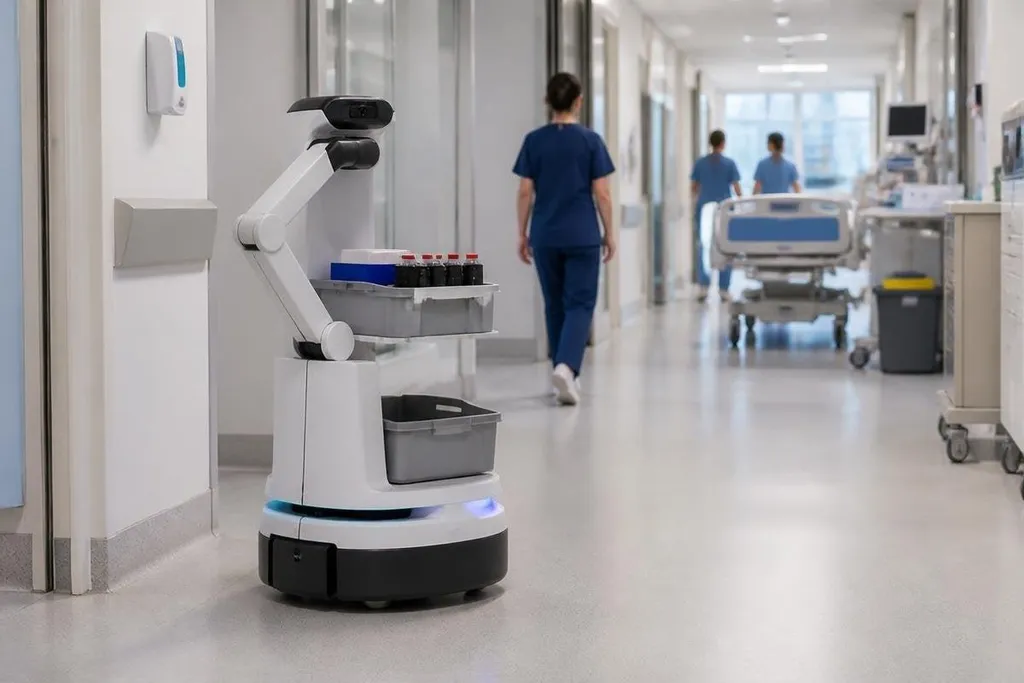
A healthcare robot has to do more than move well in a lab. It must work near people, handle errors safely, and fit the routines of a hospital where time, space, and staff are limited.
The race is spreading across surgery, rehabilitation, hospital transport, and elder care. The harder question is the same in each area: can a robot do useful work every day without adding new work for staff?
- Surgical robots need accurate motion and clear safety controls.
- Care robots must deal with people, furniture, noise, and changing plans.
- Hospital buyers need proof that a robot saves staff time after setup.
Where healthcare robots can help
Surgical robots use powered arms, cameras, and small tools to help a surgeon work inside the body. The robot does not decide what to cut. A trained person controls the system while the robot filters hand motion and moves the tools through small openings.
That setup puts heavy demands on software and safety checks. The robot must track the tool position, stop when a limit is reached, and keep the control link stable. A short delay or a wrong sensor reading can change the result of a movement measured in millimeters.
Rehabilitation robots work on a different problem. A powered brace can help move a patient’s leg or arm through a planned motion, while force sensors measure how much work the patient is doing. The setting can then change as the patient gains strength, though the care team still decides what movement is safe.
Mobile robots may carry medicine, linens, meals, or waste through a hospital. Their job sounds easier until doors, lifts, people, carts, and temporary barriers enter the route. When one needs staff to clear its path every few minutes, it has shifted the task rather than removed it.
The hard part is the hospital
Hospitals are full of spaces that change during a shift. Beds move, floors become crowded, and a delivery point may be blocked by equipment that was not there during mapping. That makes autonomous navigation harder than driving across a fixed warehouse floor.
Cameras, LiDAR, or other sensors give the robot a view of its surroundings. It also needs rules for stopping, asking for help, and giving way. Those rules matter as much as speed because a hospital robot works close to patients, visitors, nurses, and technicians.
The handoff creates another test. If a robot brings a tray to a ward, someone must know it has arrived, open the correct compartment, and confirm that the contents are right. A system that saves motion but adds checks may still fail the hospital’s real goal.
For a hospital buyer, reports on healthcare robots from Robot24.com put each promise beside a named task, ward, human handoff, and measured result. Those details give the next questions a clear test.
What buyers should ask for
A hospital should ask for operating details rather than a smooth demonstration. The useful evidence shows how the robot behaves after a blocked route, a lost signal, a low battery, or a person stepping in front of it.
The price also includes installation, mapping, staff training, service visits, software fees, and changes to doors or charging points. A robot may be affordable as hardware and costly as a working service.
I’d skip any purchase that cannot show who handles failures at 2 a.m.
The strongest proof is a clear task record. It should show how many trips or procedures the robot completed, how often staff took control, how long recovery took, and what happened when the task failed.
A practical buying checklist
Use these questions before a pilot receives approval:
- Name the task: Write down the exact job, start point, end point, and handoff.
- Count staff actions: Record every time a person loads, redirects, resets, or checks the robot.
- Test the bad cases: Block routes, remove network access, lower the battery, and place people near the path.
- Set a service plan: Confirm response times, spare parts, software support, and who owns the repair.
- Measure the result: Compare staff minutes, errors, delays, and completed tasks before and after the pilot.
This process also gives research teams a better target. A robot that lifts more weight may matter less than one that recovers from a blocked doorway without calling a nurse.
What happens next
Healthcare robots will keep improving through narrower jobs first. Moving supplies, guiding therapy exercises, and assisting with repeatable surgical tasks offer clearer limits than a general robot expected to understand every hospital situation.
The winning systems will be the ones that show safe recovery, low staff workload, and useful results over many shifts. Until buyers see those records, a polished demo remains a test of presentation, not proof that the robot is ready for care.